
DISCOVER SÉZANNE DIFFERENTLY
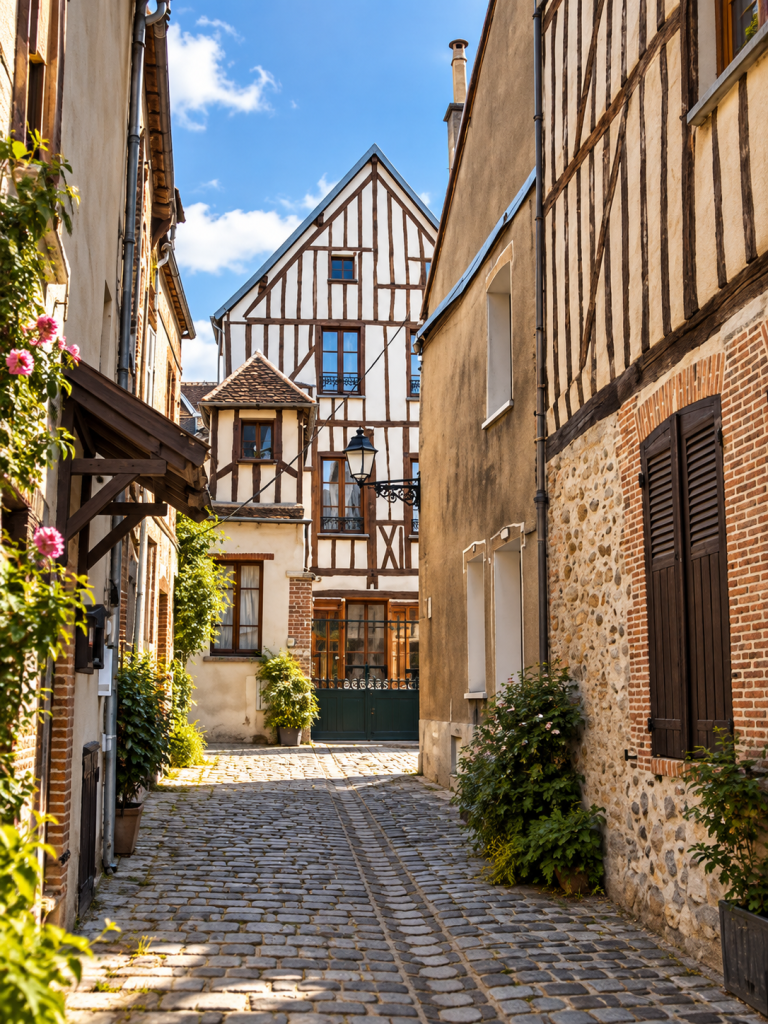
In the heart of the Champagne region, Sézanne is a small town that is easy to explore on foot. Its historic centre retains narrow streets and lanes, half-timbered houses, stone façades and many features that reflect its history.

Saint-Denis Church dominates the town centre. Around the historic heart of Sézanne, the Mails form a tree-lined belt laid out on the site of the former medieval fortifications. These promenades offer a pleasant way to walk around the old town while discovering different views of Sézanne.
Beyond the rooftops lie the surrounding hillsides, where vineyards planted mainly with Chardonnay are an immediate reminder that the town lies within the Champagne wine region.
Beneath these slopes, chalk plays an essential role. Characteristic of the Champagne subsoil, it provides good drainage while retaining the water the vines need. Part of the landscape visible above ground therefore has its origins beneath the surface.
Today, Sézanne holds the Petite Cité de Caractère® designation, which recognises and promotes its architectural and urban heritage.
A Town Rebuilt on Its History
Beneath the town lies another part of its history.
Sézanne was long a thriving trading town, particularly during the time of the Champagne fairs. A less visible legacy of this medieval past still survives: an extensive network of cellars dating from the 12th and 13th centuries, once used by merchants to store their goods.
In May 1632, a huge fire almost completely destroyed the town and its outskirts. More than 1,200 houses were lost. Sézanne was rebuilt, but many of the medieval cellars survived the disaster and became foundations for the new buildings. Beneath some of today’s houses, traces of a much older town therefore remain hidden from view.
Saint-Denis Church also survived the fire. The old fortifications, meanwhile, gradually disappeared before being filled in during the 18th century to make way for the Mails that now surround the town centre.
Sézanne at the Heart of Two World Wars
In September 1914, Sézanne found itself close to one of the major sectors of the First Battle of the Marne. The French Ninth Army, commanded by General Foch, was fighting near Sézanne and in the Saint-Gond marshes.
Today, it is difficult to imagine from the landscape that fighting on such a scale took place just a few kilometres from the town. Yet these events left a profound mark on Sézanne and the surrounding area.
Thirty years later, the town once again faced war. Bombed in May 1940 and subsequently occupied, Sézanne saw the emergence of a local Resistance movement before becoming, on 27 August 1944, the first town in the Marne to be liberated by American troops.
But discovering Sézanne from a different perspective is not only about tracing its past. The town also offers more contemporary discoveries, sometimes in places that visitors might easily overlook.
A Place Dedicated to Sculpture

This is the case with Alain Choisnet’s exhibition space, located just a few minutes from the town centre.
Here, visitors can discover bronze sculptures inspired by feminine softness, whose elegance and serenity evoke a timeless world.
The artist welcomes visitors by appointment and introduces them to his work, his creative approach and the different stages involved in creating a bronze sculpture.
This offers another way to extend a visit to Sézanne, this time through contemporary sculpture.