
ALAIN CHOISNET, SCULPTOR CAREER AND INSPIRATION
How did you come to sculpture?
I was born in Brittany in 1962, at the foot of Fougères Castle in France, but I grew up in the Paris region. I was quite quickly drawn to working life, while continuing to study philosophy, which taught me a great deal about understanding others and finding my own way of asserting myself.
I have always enjoyed working with materials and giving them form. Paper, wood, steel, plaster and clay have all, at different times, fed this desire to create. I first encountered clay more than forty years ago, but it took me time to understand all the possibilities it could offer. I simply think I was not yet ready to explore them.
Why does the feminine play such an important role in your work?
The feminine is a great source of inspiration for me. Through the natural beauty and elegance of women, I try to convey a sense of calm.
My inspiration may come from a pose glimpsed in everyday life, a photograph, a painting… I feel an emotion and want to share it. Sometimes a single pose or movement is enough to spark the idea for a sculpture.

Do you wait for inspiration to come?
No, quite the opposite. I rarely wait for inspiration to come to me: I create the conditions for it, I go looking for it.
I am not constantly searching for a new idea. I wait until I feel the time has come to commit myself to a new creation, and from that point on, I look for what will spark it.
Once the idea appears, however, I need to give it form quickly. I can feel genuinely frustrated when I am unable to bring what I have in mind to life straight away, through lack of time or availability.
Have any sculptors been particularly important to you?
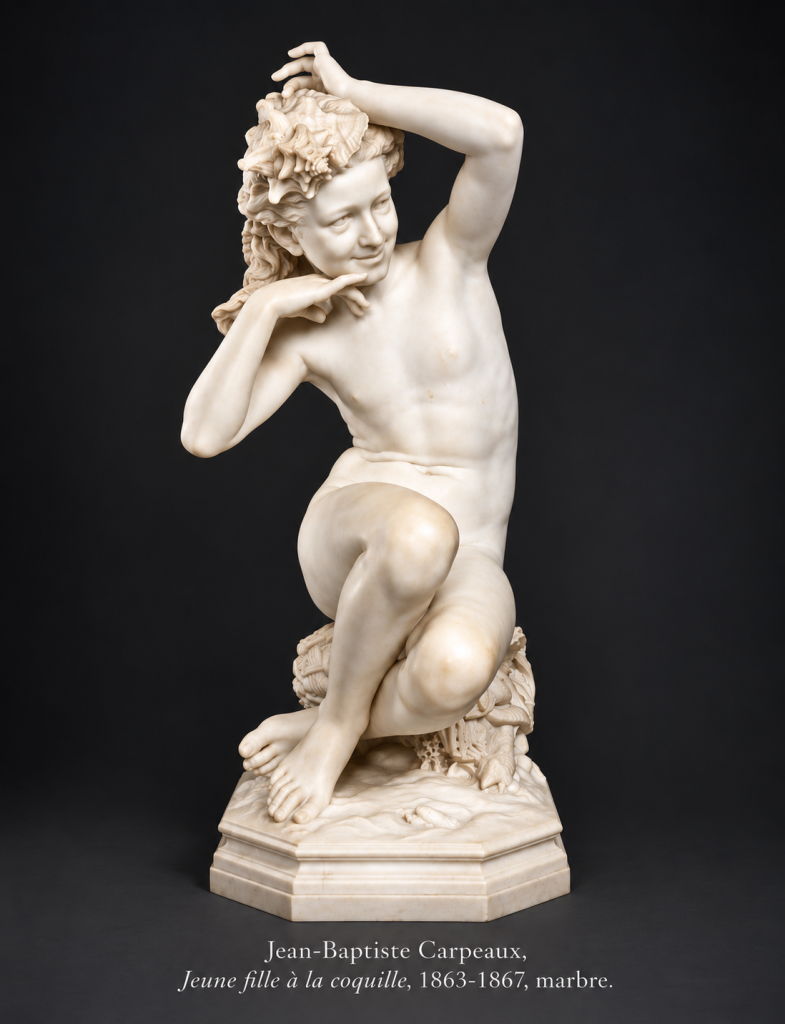
Some sculptures evoke a very powerful emotion in me. That is what affects me first. Then, when I look more closely at the work itself, I admire the precision, the pursuit of beauty and the attention paid to the smallest detail.
I find this in certain sculptors of the Italian Renaissance as well as in nineteenth-century artists. It is not so much their styles or the periods they belonged to that inspire me, but what they managed to achieve.
Sometimes, simply seeing a few of their works again is enough to make me want to create immediately. For me, they are an inexhaustible source of inspiration.
How does a sculpture take shape?
Once I have found the pose and the emotion I want it to convey, I begin by constructing the sculpture in my mind. This is probably one of the stages I enjoy most, because the sculpture already exists in my imagination before I even start working with clay.
Then comes the challenge of bringing it to life as faithfully as possible. I work mainly with clay and plastiline, using very few tools: a few modelling tools, loop tools and brushes. I also use wooden cuticle pushers, normally intended for manicures, and even toothpicks to work on certain details of faces in clay.
I prefer to work on one sculpture at a time so that I can remain focused on the original idea until it is complete. I rarely spend an entire day working on a sculpture: as soon as I feel I am losing perspective on what I am doing, I prefer to stop, sometimes for several days, and then return to it with fresh eyes.

How do you feel when a sculpture is finished?
It is quite a particular moment. As long as a sculpture is still in progress, it occupies part of my mind. Once it is finished, I regain a sense of mental freedom. And, paradoxically, no sooner has that freedom returned than there is only one thing I want to do: immerse myself in a new creation.
What makes a sculpture successful for you?
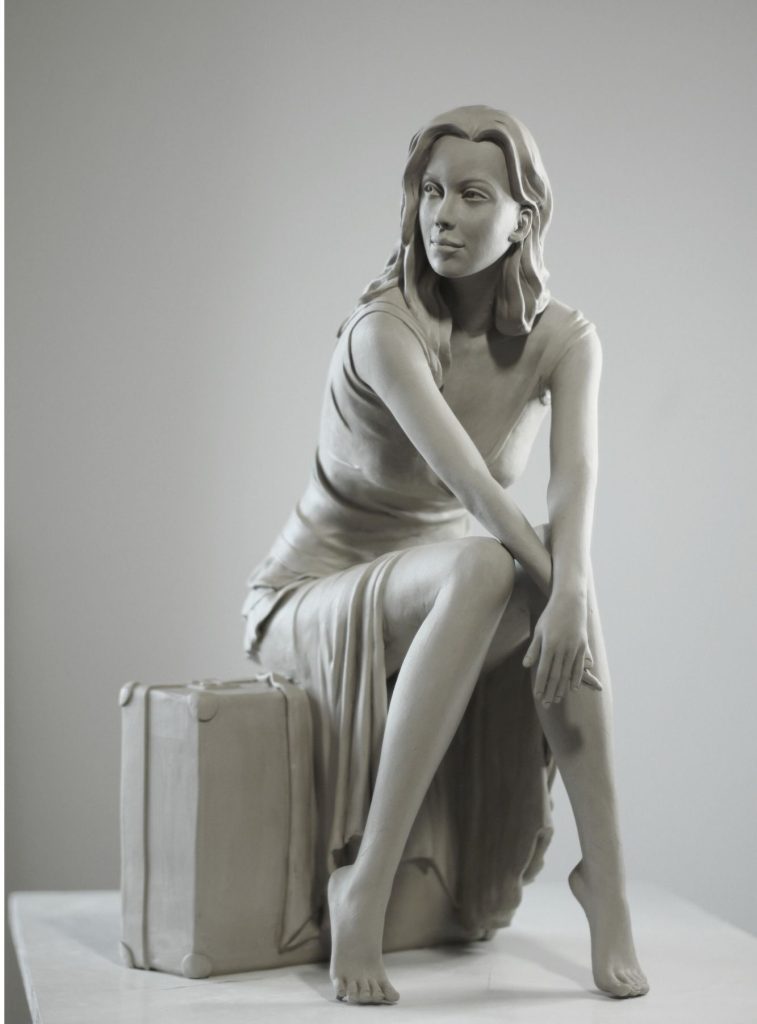
It is not necessarily the one I consider the most technically accomplished. A sculpture is successful when it manages to convey something close to what I felt at the outset.
But I have also learnt not to tell someone looking at one of my sculptures what they should see in it. What happens between a person and a sculpture belongs to them. They may find something in it that I had never imagined myself.
That is why I say very little about my sculptures. Giving my own interpretation could influence that of others. I prefer to let each person discover what a sculpture evokes in them.
Does the opinion of others influence your work?
Tastes naturally differ from one person to another. I completely understand that some of my sculptures may not appeal to everyone. On the other hand, it is important to recognise and distance yourself from those whose comments, under the guise of criticism, are subtly disparaging.
Technical comments interest me more. I believe I always have something to learn, and I am very willing to listen to anything that can help me improve.
What place does sculpture have in your life?
I still see it more as a passion than a profession, even though it has become my occupation. Being able to devote my time to creating remains a privilege for me.
Sculpture inevitably occupies an important place in my life, but I also want to preserve the freedom with which I began: to create when I feel like it, choose my own subjects and remain in control of my work.