
THE PATINA OF A BRONZE SCULPTURE
Much More Than a Colour
After the chasing and finishing of the metal, bronze naturally has a golden colour. Patination profoundly changes its appearance, giving it the colour chosen by the artist.
Browns, blacks, greens, reds or lighter tones can be achieved depending on the products used and the way they react with the metal.
Patination is therefore one of the final stages in creating a bronze sculpture, but also one of the most decisive in determining its finished appearance.
The Artist’s Choice of Patina
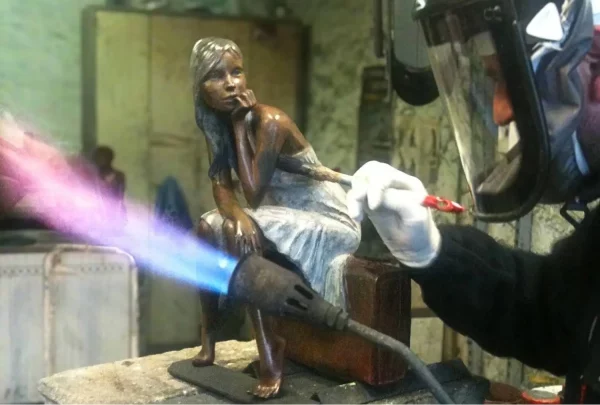
The patination itself is carried out by the patinator, while the artist chooses the colour.
For each sculpture, Alain Choisnet works with the patinator to define the patina when the first example is produced. This then becomes the reference for the entire edition.
For subsequent examples, the patinator aims to reproduce this reference patina while taking into account the individual reactions of each bronze.
How Is a Patina Created?
Unlike paint, a patina is not simply a colour applied to the surface of the bronze. It results from chemical reactions induced directly on the metal.
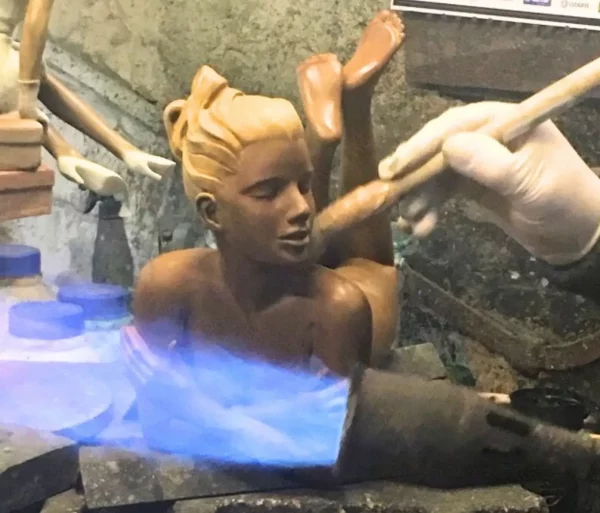
The patinator gradually heats the sculpture with a torch before applying different chemicals, usually with a brush. The temperature of the bronze, the composition and concentration of the solutions, and the number of applications can produce very different results.
There is therefore no single formula for mechanically reproducing a patina. The patinator’s expertise relies largely on experience and a thorough understanding of how bronze reacts.
Preparing the Bronze
Before patination begins, the surface must be carefully prepared. Any traces that could interfere with the chemical reactions are removed to ensure the metal is perfectly clean.
The sculpture can then be gradually heated. The patinator begins the first applications and immediately observes how the bronze reacts.
This preparation is important: a surface that has been unevenly cleaned or prepared can affect the final result.
A Gradual Process
The final colour does not usually appear after a single application. The patinator works in successive stages, varying the products, their concentration and the temperature of the metal.
Some areas may be treated several times to intensify or, conversely, soften a particular tone. This gradual process creates nuances that a uniform application of colour could not achieve.
This also explains why a hand-applied patina may show slight variations from one example of the same sculpture to another.
Wax, the Final Step
Once the patina is complete, a thin layer of wax is applied to the bronze. It protects the surface and helps preserve its appearance.
The sculpture is then polished. This is the final stage in finishing the bronze.
The wax will need to be renewed occasionally, depending on the conditions in which the sculpture is kept.
→ Caring for a Bronze Sculpture
A Decisive Stage for Alain Choisnet
Browns play an important role in Alain Choisnet’s work, often combined with white or other tones depending on the sculpture.
The choice of these colours is considered from the creation of each model and finalised when the first bronze is produced.