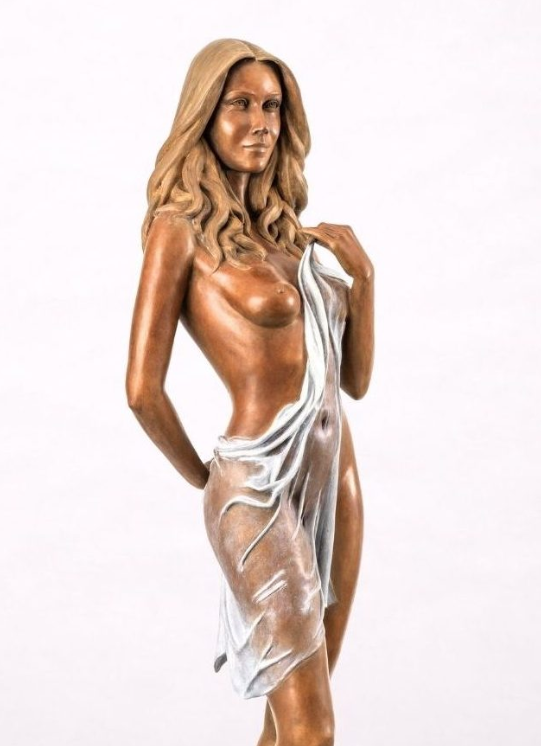
CONTEMPORARY BRONZE DRAPED WOMAN
Drapery has played an important role throughout the history of sculpture. Whether used as clothing or simply as fabric, it allows the sculptor to explore folds, volumes and what is revealed or concealed.
Among the different ways of working with drapery, one of the most remarkable is to give an opaque material the appearance of an almost transparent fabric.
When Stone Creates the Illusion of Transparent Fabric
How can the transparency of a veil be represented in a sculpture made from a completely opaque material?
Greek sculptors were already confronting this challenge in antiquity. In the 5th century BCE, they developed a way of depicting clothing that art historians now refer to as “wet drapery”.
The principle is to depict fabric that appears to cling to the skin as though it were wet. The folds are worked in such a way that the forms beneath the garment remain visible without the fabric itself disappearing.
This technique allows artists to represent nudity and clothing simultaneously. Marble, despite being opaque and rigid, creates the illusion of light fabric that can appear almost transparent.
The Winged Victory of Samothrace: a Remarkable Example
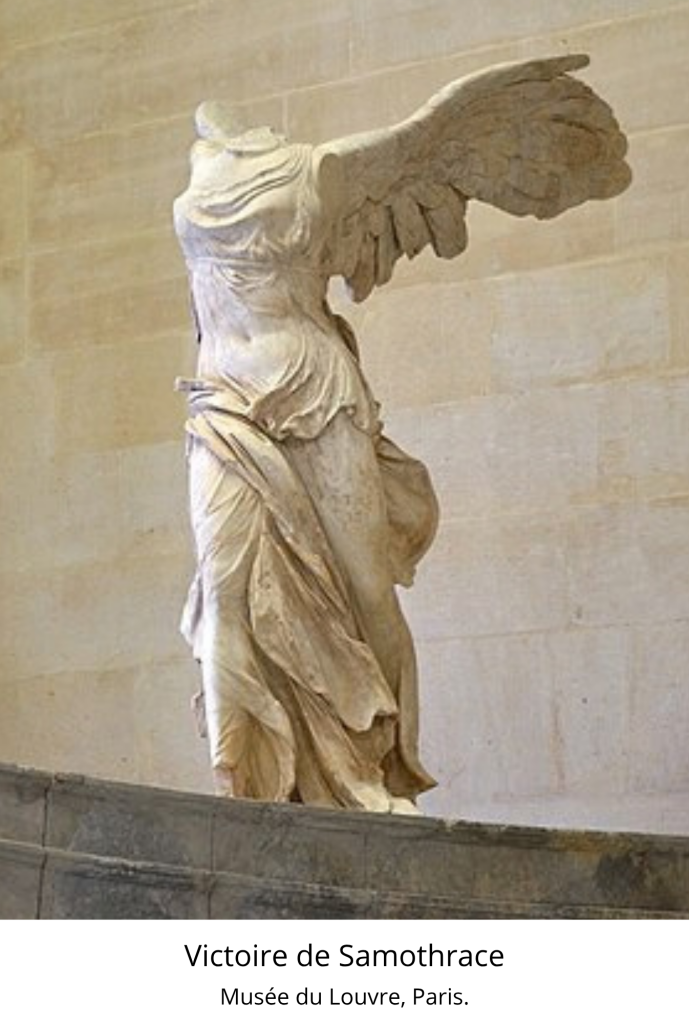
The famous Winged Victory of Samothrace, housed in the Louvre Museum, is a particularly striking example of the mastery of drapery.
Created at the beginning of the 2nd century BCE, the sculpture depicts the goddess Nike, who appears to be alighting on the prow of a ship.
Her garment seems to be pressed against her by the wind, revealing the forms beneath. Elsewhere, the folds lift and flow freely. The sculptor thus succeeds in suggesting both the lightness of the fabric and the force of movement.
Part of the work’s fascination lies in the contrast between areas where the garment appears almost transparent and those where it takes on a volume of its own.
The Veil: a Challenge for Sculptors
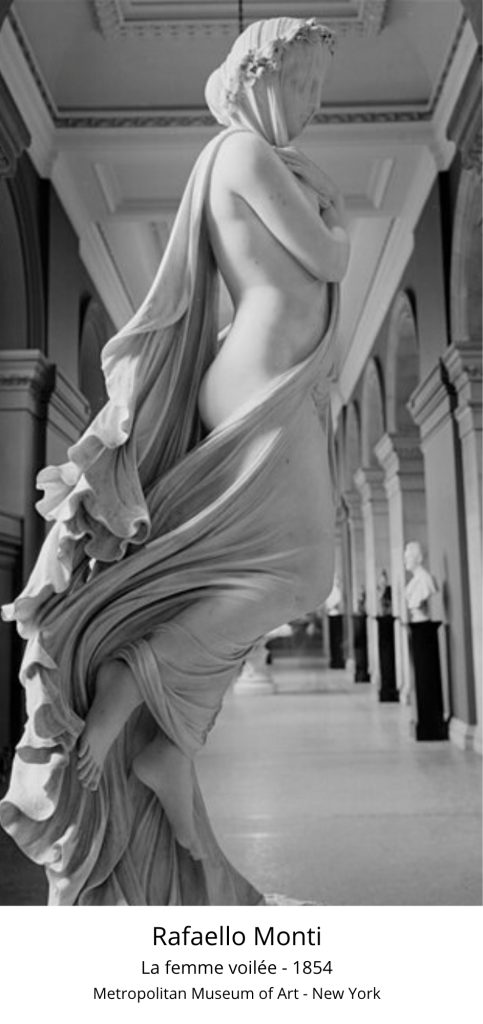
This pursuit did not end with antiquity. In the 19th century, some sculptors took the illusion of transparency even further.
The Italian sculptor Raffaele Monti became particularly renowned for his sculptures of veiled women. In The Veiled Lady, created in 1854, the marble seems to become an extremely fine fabric through which the features of the face emerge.
Yet the veil is not made from a different material: it is carved from the same block of marble as the face it covers.
The success of this illusion lies in the treatment of the relief. The sculptor must make the viewer feel that they are looking at a face through fabric, even though they are seeing only a single surface of marble.
Although these historical examples are carved in marble, the pursuit of transparency is not limited to this material. Bronze offers other possibilities, particularly through the use of patina, which can enhance the illusion created by the modelling.
Drapery in Alain Choisnet’s Sculptures
In Alain Choisnet’s sculptures, drapery may envelop a woman almost entirely or cover only part of her nudity. Patinas also help distinguish the fabric from the exposed areas and emphasise the drapery.
Charlotte offers a distinctive interpretation. The modelling of the veil and the use of patina work together to create an impression of transparency. Subtle variations in colour enhance this effect, giving the bronze the appearance of a light, delicate fabric.